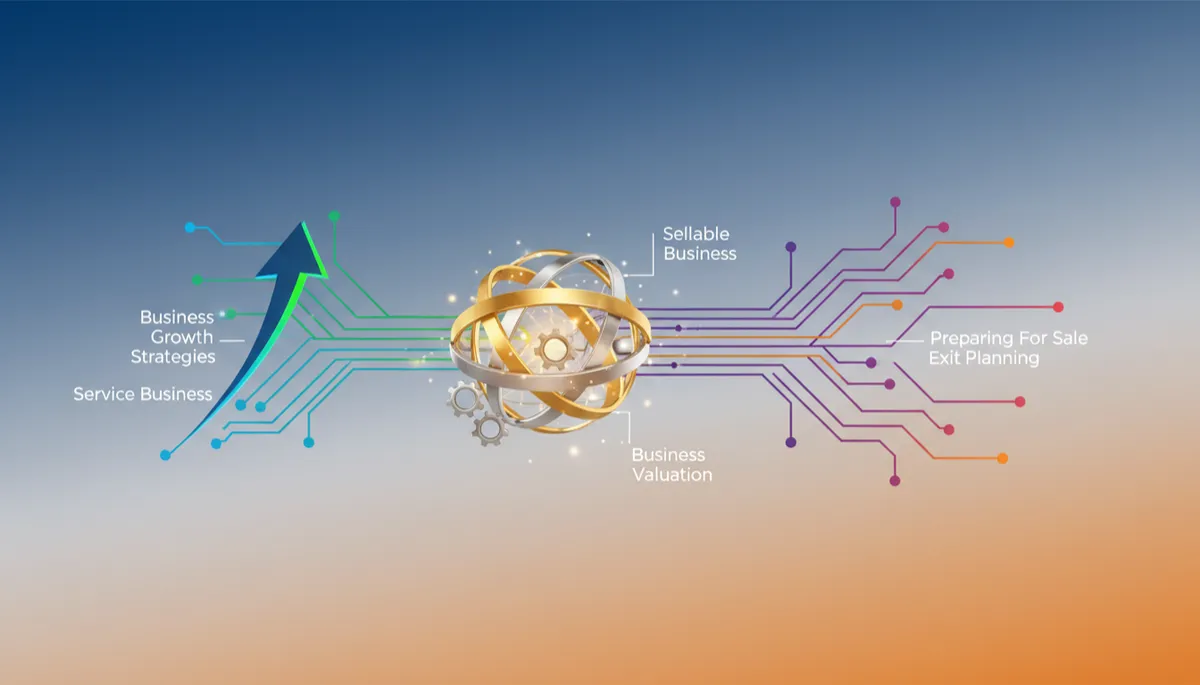
Make Your Service Business Sellable Before Exit
Service Business, Exit Planning, Business Growth Strategies
How to Make Your Service Business Sellable Long Before You’re Ready to Exit
If you run a growing service business, you may not be ready to sell today. You might not even be sure you ever want to. But building a Sellable Business isn’t only about an eventual exit — it’s about creating a company that can grow without burning you out, holds real equity value, and gives you options when life or the market changes.
Why “Sellable” Matters Even If You’re Not Selling
In a typical Service Business, the owner is the rainmaker, the problem-solver, and often the bottleneck. That works in the early years. Eventually, though, the business becomes more complex than you can manage alone or fix with generic frameworks. At that point, “just grow harder” stops working — and exhaustion sets in.
Making your company a Sellable Business changes that dynamic. Buyers — whether it’s a strategic acquirer, a partner, or even a future internal leadership team — pay for three things:
Predictable revenue and profit
Systems that don’t depend on one person (you)
A team that can run the business day to day
Those same ingredients also give you something owners rarely have: choice. You can keep growing, step back into a true leadership role, or begin Exit Planning on a timeline that fits your life — not your stress level.
💡 Pro Tip: “Sellable” is really another word for “transferable and sustainable.” If the business can’t run without you, it isn’t sellable — and it isn’t truly free either.
Step 1: Start with Mindset — From Operator to Asset Builder
At Steve Thompson Coaching, we see the same turning point again and again. Owners realize they’ve built a demanding job, not an asset. The first shift in our MVP framework — Mindset — is deciding that your service business should work for you, not the other way around.
That means:
Seeing yourself less as “chief doer” and more as the architect of a sellable asset
Valuing systems and leadership as much as sales and hustle
Being willing to step out of some seats so others can step in
Without this mindset shift, every other change will feel like adding work. With it, Preparing For Sale becomes a way to reclaim your time and sanity now, not just to chase a future payday.
Step 2: Clarify Your Vision and Exit Options Early
You don’t need a firm exit date to start Exit Planning. You do need a clear vision of what “freedom” looks like for you. For some business owners, that’s selling to a strategic buyer in five to seven years. For others, it’s building a leadership team that can run the company while they work part-time, or eventually transitioning ownership to key employees.
Ask yourself:
How involved do I want to be in three, five, and ten years?
What income do I need from the business, both now and after an eventual exit?
Would I prefer to sell outright, merge, or gradually hand over ownership?
This is the Vision piece of the MVP framework. When you’re clear on where you’re heading, you can choose Business Growth Strategies that support that path instead of chasing every opportunity that shows up.
Step 3: Understand What Drives Business Valuation in Services
A potential buyer looks at your Business Valuation very differently from how you experience your business day to day. They’re asking, “If I buy this, how confident am I that the revenue and profit will continue — or grow — without the current owner in the middle of everything?”
For service businesses, some of the biggest value drivers are:
Recurring or retainer revenue: Subscriptions, long-term contracts, and retainers are valued higher than one-off projects or “heroic” sales.
Client concentration: If one client is 40% of revenue, risk — and valuation discounts — go up.
Owner dependence: The more clients insist on “only working with you,” the less transferable the business is.
Documented systems: Clear processes for delivery, sales, finance, and operations reduce perceived risk.
Improving these levers doesn’t just boost a future valuation. It also stabilizes cash flow, reduces chaos, and makes it easier to grow without working nights and weekends forever.

Clarifying systems and metrics turns a personality-driven practice into a transferable asset.
Step 4: Systematize the Work You Want to Keep — and the Work You Want to Hand Off
Many owners hear “systems” and picture a rigid playbook that squeezes the life out of their service business. That’s not the goal. At Steve Thompson Coaching, we use the Bloom Growth operating system to build just enough structure so your team can deliver consistently — while still leaving room for expertise and creativity.
Start with the processes that matter most to a buyer and to your sanity:
How clients are onboarded and scoped, so expectations are clear and margins are protected
How work is delivered, reviewed, and approved, so quality doesn’t depend on one “hero” employee
How you forecast, price, and track profitability by client or project
Document the 20% of steps that create 80% of the consistency. This is where “your path, not a playbook” matters. The best system is the one your team will actually use, because it reflects how your business really works — not a generic template from a book or webinar.
Step 5: Build a Leadership Team That Can Carry the Business Forward
A Sellable Business has more than a strong owner; it has a leadership team that can think, decide, and lead without you in every meeting. For service businesses, that usually means clear ownership of:
Sales and client relationships
Service delivery and quality
Operations and finance
You don’t have to hire a full executive layer overnight. Often, the first step is clarifying roles and expectations for the people you already have, then coaching them to make decisions you currently hold. This is where the “whole person and whole business” approach matters: you’re not just installing titles; you’re helping people grow into new levels of responsibility and ownership.
💡 Pro Tip: A future buyer will look closely at your leadership meetings, scorecards, and accountability. If your team can run a weekly meeting that moves the business forward without you driving every item, you’re on the right track.
Step 6: Choose Business Growth Strategies That Increase Optionality, Not Just Revenue
Not all growth is created equal. Some growth makes your service business more valuable and sellable; some just makes it heavier and more chaotic. When you’re Preparing For Sale — even years in advance — your Business Growth Strategies should focus on:
Increasing recurring or retainer revenue versus one-time projects
Deepening your niche and positioning so you’re not just “another” provider
Reducing client concentration risk as you scale
Improving margins through pricing discipline and scope control
In practice, that might mean saying “no” to custom, one-off work that pulls you back into the weeds — even if it’s lucrative in the short term — so you can double down on offerings that can be delivered by your team, at scale, with consistent quality.
Step 7: Turn Exit Planning into an Ongoing Discipline, Not a Last-Minute Project
Owners often wait until they’re exhausted, burned out, or facing a life event before they think seriously about an exit. That’s when leverage is lowest and options are most limited. Instead, treat Exit Planning as a regular strategic discipline — just like budgeting or marketing planning.
A simple rhythm might include:
Reviewing your personal goals and desired role annually
Getting a high-level sense of Business Valuation every 12–24 months from a trusted advisor
Identifying one or two key de-risking moves each quarter (for example, reducing client concentration or documenting a critical process)
This steady, structured approach is how you quietly transform a demanding, personality-driven practice into a calm, transferable, Sellable Business over time.
Bringing It All Together: Your Path, Not Someone Else’s Playbook
Making your service business sellable before you’re ready to sell is ultimately about regaining control. It’s about building a company that doesn’t rely on your constant presence, that rewards the years you’ve invested, and that leaves you with real options — to grow, to step back, or to exit on your own terms.
At Steve Thompson Coaching, we don’t hand you a rigid formula. We walk with you through the MVP framework — Mindset, Vision, Plan — and implement the Bloom Growth operating system so that your systems and your leadership grow together. The result is clarity instead of chaos, accountability instead of constant firefighting, and a business that can thrive with or without you in every seat.
If your service business has become too complex to run on hustle and instinct alone, now is the right time to start Preparing For Sale — even if you never plan to sell. You’re really preparing for freedom: the freedom to choose your role, your pace, and your path forward.
Your Next Step: Turn a Demanding Job into a Sellable Business
You don’t have to figure this out alone — and you don’t need to force your business into someone else’s blueprint. Together, we can design a path that fits you, your team, and your market, while steadily increasing the value and sellability of what you’ve built.
Ready to explore what a sellable, scalable future could look like for your service business?
1. Book a discovery call with Steve Thompson Coaching.
2. Create a tailored plan that aligns your Mindset, Vision, and Plan.
3. Execute with support — and realize the freedom you’ve been working for all along.
Ready to find your root?
Book a free sample session and map out what forward looks like for you.